Press Release API documentation
Distribute press releases programmatically with a simple, predictable REST API — or let an AI assistant wire it up for you in minutes.
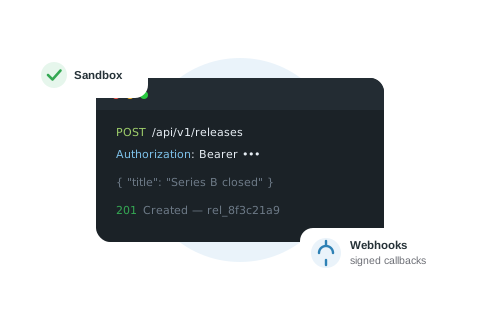
Distribute press releases programmatically with a simple, predictable REST API — or let an AI assistant wire it up for you in minutes.
The News Source API is a JSON-over-HTTPS REST interface. Authenticate with a bearer token, POST your release, and we handle distribution to Google News, Bing News, MSN and the rest of the network.
All requests go to a single, versioned base URL over HTTPS:
https://api.newssourcepr.com/v1
Every request must include your secret key in an Authorization
header as a bearer token. Keys are scoped to your account and can be rotated at any time.
reference field.Looking for the product overview instead? See the press release API service page.
submit-release.sh
# Submit a press release for distribution
curl -X POST https://api.newssourcepr.com/v1/releases \
  -H "Authorization: Bearer YOUR_API_KEY" \
  -H "Content-Type: application/json" \
  -d '{
    "title": "Acme Robotics Launches Autonomous Warehouse Platform",
    "body": "Acme Robotics today announced the general availability...",
    "company": "Acme Robotics, Inc.",
    "contact_email": "press@acmerobotics.com",
    "category": "Technology",
    "distribution": "full-bundle",
    "reference": "acme-launch-2026-06"
  }'
Write it yourself, have an AI assistant write it for you, or skip the code entirely.
Opens Claude with a ready-made prompt carrying every endpoint, the auth header and the webhook rules from this page. Name your language and it writes the client for you.
Open the Claude promptThe same prepared brief for ChatGPT. Add your stack and it returns working code with retry and signature-verification logic already in place.
Open the ChatGPT promptSkip the client entirely. PR Software talks to our distribution network for you, so releases go out and statuses come back through a ready-made interface.
Connect with PR SoftwareCreate, label and revoke API keys from your account dashboard. Use separate keys
for production and testing, and pass the key as Authorization: Bearer YOUR_API_KEY on
every call. Never embed keys in client-side code — keep them server-side and rotate
immediately if one is exposed.
Four endpoints cover the full lifecycle: submit a release, poll its distribution status, fetch published links, and verify your integration against the sandbox.
/releasesSubmit a new press release for distribution and receive a release ID for tracking.
/status/{id}Retrieve the current distribution status of a release — queued, processing or published.
/links/{id}List the live published URLs and the outlets where a release has appeared.
/testSandbox health check — verify authentication and connectivity without consuming distribution credits.
A successful submission returns the release ID, current status and — once distributed — the outlets and live links.
GET /status/rel_8f3c21a9
{
  "id": "rel_8f3c21a9",
  "reference": "acme-launch-2026-06",
  "status": "published",
  "submitted_at": "2026-06-18T14:02:11Z",
  "published_at": "2026-06-18T15:02:47Z",
  "distribution": "full-bundle",
  "links_total": 1000,
  "links": [
    { "outlet": "Google News", "url": "https://news.google.com/..." },
    { "outlet": "Bing News",   "url": "https://www.bing.com/news/..." },
    { "outlet": "MSN",         "url": "https://www.msn.com/..." }
  ]
}
Pass a single outlet in the distribution field, or full-bundle to reach every outlet below in one call.









Everything you need to integrate press release distribution confidently and at scale.
Subscribe to status events and receive a signed callback the moment a release is published, so you never have to poll.
Generous, transparent limits with X-RateLimit headers on every response and clear
429 retry guidance.
Use a test key to validate payloads end to end against /test without spending credits
or publishing live.
Authorization: Bearer YOUR_API_KEY header. Keys are server-side secrets — never expose them in browser or mobile clients. You can issue multiple keys and revoke any of them instantly.reference field you control for idempotency and reconciliation.X-RateLimit-Limit, X-RateLimit-Remaining and X-RateLimit-Reset headers. If you exceed your tier's limit you receive a 429 Too Many Requests with a Retry-After value. Need higher throughput for bulk distribution? Talk to us about a volume plan.GET /test to confirm connectivity and authentication. Submissions made with a test key are validated and echoed back but never published live and never consume distribution credits — ideal for CI pipelines and staging.distribution value to target a single outlet, or "full-bundle" to send to every outlet at once. The identifiers and prices match the pricing table exactly.